
24th April 2026
The ANZAC biscuit is a product of early 20th-century wartime logistics, food science constraints, and trans-Tasman mobilisation during the First World War.
Its origins are generally placed between 1914 and 1918, the duration of the First World War, when families in New Zealand and Australia began producing long-life baked goods for soldiers serving in the Australian and New Zealand Army Corps.
Unlike many modern recipes that evolved in domestic kitchens, the ANZAC biscuit was shaped by shipping constraints and ingredient scarcity. Standard military care packages sent from Australasia to the Western Front often took 4–6 weeks by sea, followed by rail transport across Europe.
This created strict requirements: food had to withstand high humidity, long storage times, and temperature fluctuations exceeding 20°C–35°C during transit routes through the Indian Ocean and Mediterranean supply chains.
The defining characteristic of the biscuit—its absence of eggs—was not symbolic but practical. Eggs were both expensive and perishable, and wartime rationing reduced civilian access.
Instead, structural binding relied on rolled oats, flour, and golden syrup, the latter of which has a low water activity level (~0.75–0.85 aw), helping inhibit microbial growth and extending shelf stability.
By the late war period (1917–1918), recipes resembling modern ANZAC biscuits began appearing in fundraising cookbooks and Red Cross publications across New Zealand and Australia.
Early references often labelled them “soldiers’ biscuits” or “oat biscuits,” with the term “ANZAC biscuit” becoming more common in the 1920s and 1930s, as remembrance culture expanded following the establishment of ANZAC Day on April 25.
The biscuit’s transition from utilitarian ration food to cultural symbol reflects broader post-war commemorative practice.
By the mid-20th century, ANZAC biscuits were firmly embedded in school curricula, memorial fundraising events, and domestic baking traditions, reinforcing their association with wartime endurance, resource efficiency, and civilian contribution to military logistics.
How to make Anzac biscuits to your taste
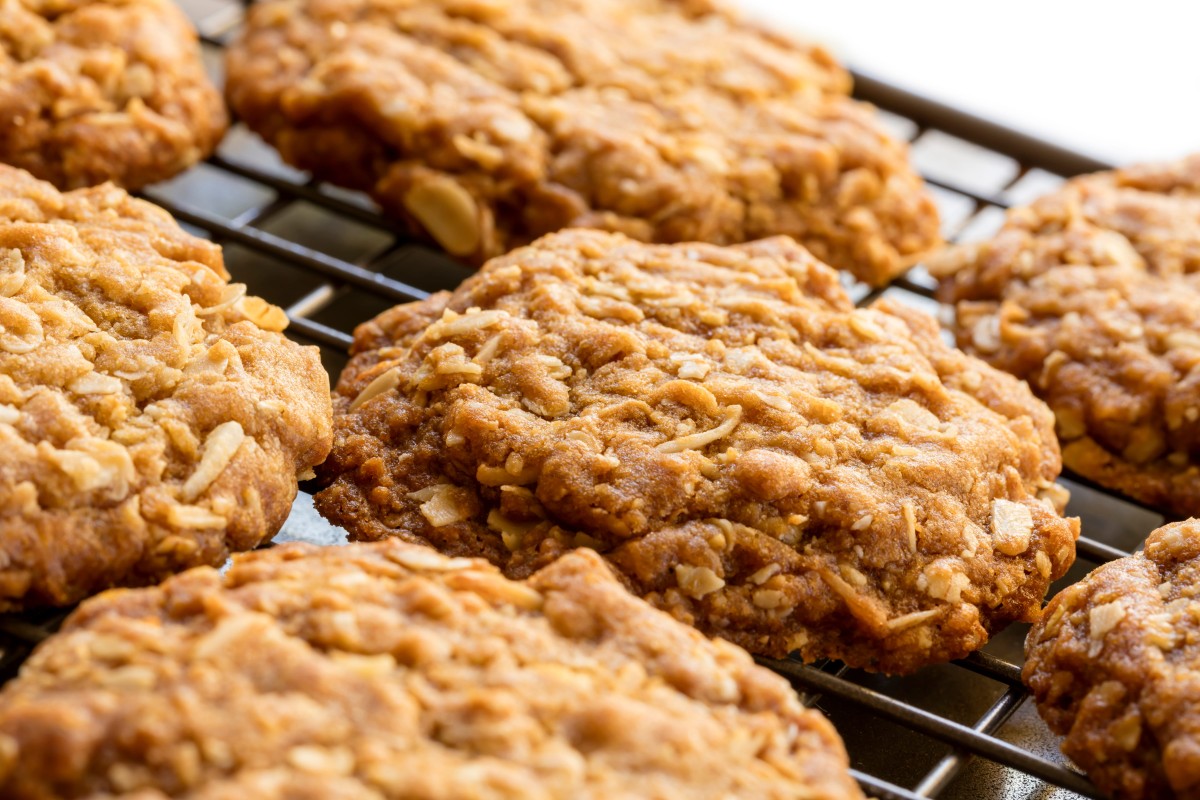
A traditional Anzac biscuit recipe is as follows. But, for a softer and chewier texture, bake them for around three minutes less, add more golden syrup, and replace a couple tablespoons of flour with extra oats.
Across all versions, the structural foundation remains consistent: oats provide bulk, sugar delivers caramelisation, and golden syrup or its substitutes bind the mixture.
Gluten-free versions replace standard flour with gluten-free blends and require certified gluten-free oats, producing a slightly more crumbly but otherwise familiar result.
Honey-based variations substitute part or all of the golden syrup with honey, giving a lighter, more floral sweetness and a softer bite due to higher moisture content.
Chocolate ANZAC biscuits add chocolate chips or cocoa powder, shifting the biscuit into a richer, dessert-style format while maintaining structural integrity from the oats.
Seed and nut versions incorporate ingredients like almonds, walnuts, sunflower seeds, or chia for added crunch, protein, and complexity, often aligning with modern “healthier baking” trends.
Vegan adaptations stay closest to the original wartime formulation, typically swapping butter for coconut oil or plant-based margarine while retaining golden syrup or plant alternatives, resulting in a very similar texture and flavour.
Despite these variations, all versions remain conceptually tied to the original biscuit associated with ANZAC Day, preserving its identity as both a practical wartime food and a lasting symbol of remembrance.
Ingredients:
· 1 cup rolled oats
· 1 cup plain flour
· 1 cup desiccated coconut
· 3/4 cup brown sugar
· 125g butter
· 2 tbsp golden syrup
· 1 tsp baking soda
· 2 tbsp boiling water
Method:
· Preheat oven to 160°C (320°F) and line a tray with baking paper.
· Mix oats, flour, coconut, and sugar in a bowl.
· Melt butter and golden syrup together in a saucepan.
· Dissolve baking soda in boiling water, then add to the butter mixture (it will foam).
· Combine wet and dry ingredients.
· Roll into balls, place on tray, and flatten slightly.
· Bake for 12–15 minutes until golden. Cool on a rack.